The Lost Tables
Jumping and Falling
This compilation is created with the use of the Boxed set of Alphatia/Thyats, The Rules Cyclopedia, The AD&D Wilderness survival guide, and some other more obscure sources (Dragon Magazines).
 |
| Source; AD&D Wilderness Survival guide |
Lucius wanders through the forest.
As a strong man he is not afraid
of the dangers lurking in the Radlebb
Woods. Instead, he is proud, wearing a leather Armor and a woodman’s axe, ready
to become an adult. Yes, Lucius is in his Shearing period. With torn pants and
coat he accepted this almost ritualistic tradition of the Traldar, even while
he himself is of Thyatian heritage. It were his friends, he followed,
Bartholomew, a Traladaran/Darokin merchant son, and Oswald, a pure blood Traladaran,
proud of his deep routed heritage.
After a few hours walking he
encounters his friends in an open place several miles North East of Luln. At
first he notices Oswald who successfully releases his first magic missile, then
learning that the spell once cast is lost. Lucius steps forward. “Hi
Bartholomew, that was a magnificent example of magic you did there. Does it do
something else than blasting branches?”
“You, dim-witted buffoon, that was my first and only spell for today. I’m just an Apprentice. Now I have nothing
except my Pole.” Lucius spied around and saw indeed a pole, longer than
expected, a full 20’ tall. “That…. Thing?. That would only be a hindrance. You
can’t slam an Orc with it, for it is way too long, … and you’re way too weak.”
A voice behind Lucius responds. With a quick turn Lucius notices it is Oswald,
sitting high up in a tree. “It is not all
Strength you need, maybe in battle, but the subtle twist of a dexterous
feet can easily tip the balance, my friend.” With a side swing he leapt from
the tree, landing on the ground safely. “We know, that as a woodsman, you learn
to trust upon your muscles, but we prefer to trust our knowledge and skills a
bit different”
“I bet, you can’t make the same
simple leap I just made.” Oswald taunts.
“Maybe our nimble friend is right
Lucius, maybe we should explain you something about… jumping.” Bartholomew
speaks. “ And about Falling” Oswald
fills is, with a wide sneer about his face.
“Yes, these two are connected to
eachother like the kernel within the apple.”
“Ehh… wha..do… ya… mean?
Lucius responds, his simple mind
clearly confused by this sudden burst of
input of knowledge.
“Did you ever jump? Did you ever
jump over a ditch? As far as you could?”
Ehh… Yeah, but why…Ehh of course I
can jump….Farther than any of you
guys.” Julius regrasps his reality.” I’m way stronger than you so I can jump
father, higher, en ehh. Faster.”
“Sure?, Then lest try, Lets do
some training. Do you see that gulley
there? It’s only about 9’ wide and 10’ deep. Would you be able to cross that?”
Taunts Oswald again. “Of course”, the young proud fighter bolsters. “Be
careful” Bartholomew responds softly, not wanting to intimidate the strong
friend.
“Ok, we jump together.” Lucius
speaks proudly, and walks to the rim of the Gulley.
Then he bends his knees and pulls
all his strength in it, and with a burts of the fellow’s muscles he leaves the
ground forward.
At the same time both Bartholomew
and Oswald run past Lucius. Bartholomew with the absurdly long pole and Oswald
as he is. They too make the jump.
A General Word about Skills.
Any 1st level character begins with at least 4 skills, these are reflections what the character has
learned in his If the character has a higher Intelligence than he gains another
skill for each Intelligence bonus the character has from his Intelligence
score. This means that if he has Intelligence of 13-15, he has one extra skill,
16-17, he has two extra skills, and 18, he even has three extra skills. Some
nationalities or races have another way of raising their
youngsters, by schooling them as an example and enable the character some extra
skills. But this is rare and the amount of skills attained this way is never
more than 2 in total. All these skills are determined by several factors. The
character could have chosen them himself; some can be chosen for him; some are
based upon the character’s race, culture, religion, nationality, social class,
profession of parents, the character’s origin and who knows what more.
Each general
skill is based on one of the character’s abilities (Strength, Intelligence,
Wisdom, Dexterity, Constitution and Charisma). To know the score of a single
skill a character begins with roll 8+1d10, that was the score equal to
that from the last teacher, if this is higher than the ability the character
has, the score is derived from the used ability instead. For example a
character has Intelligence 14, and has a knowledge skill learned from a teacher
who had a score of 12 for that skill, then the character will also have only a
12 on that skill. But if the teacher had a 15, his skill score would be 14
basically, his own limit.
Whenever a character’s skill is
appropriate to the current situation, the player rolls a 1d20 against his
current score with the ability. If the roll on the 1d20 is equal or less than
the ability score, the skill use succeeds. A roll of 20 always fails, no matter
how high the chance for success. For example, if the character is riding a
horse and the horse is suddenly spooked and begins rearing. The character’s
player than rolls 1d20 against his Ridiing skill score. If the character’s
skill ability is a 15, the player has only to roll a 15 or less to successfully
use the skill. This roll is called a “skill roll” or “skill check”. A
successful check means the character succeeds in the task he was attempting. If
a character is trying to track an animal through the forest, and he
successfully makes his tracking skill check, then he is able to follow the
tracks of his prey. Of course, to use the skill, the character must have all
the tools and materials to do the job. A carpenter can do very little without
his tools, and a smith is virtually helpless without a good forge. The
character must also have enough time to do the job. Certainly, carpentry Skill
enables your character to build a house, but not in a single day. Some Skill
descriptions state how much time is required for certain jobs. Most, however,
are left to the DM's judgment.
DM
 Every character can jump, except when it’s corporeal state prevents this
(broken leg, spine, KO, etc.).
The distance of a Jump is dictated
by the character’s current strength, and partially by its size. Smaller creatures of half human size or less suffer a penalty of 1 on each jumping roll, but if they have a jumping skill, their distances increase by +2 per succesul roll. Giant creatures of sizes larger than humans add one quarter of their length to the jump, and suffer a penalty on any dexterity check of -5!!. If they land on a creature it suffers 2d6 x2 impact damage. If they fall, they are prone for 2 rounds instead of 1. This reflects the difficulty of their size and weight to jump).
But the jump can be increased by use of
the Jumping skill. Dexterity dictates
how the character lands, in all cases.
There are three main sorts of
jumping.
A Standing Broad Jump,
starting the jump from the character’s current position.
A Running Broad Jump;
Running at least 20’ and then starting the jump from the character’s current
position.
A High Jump; where the
character jumps upwards from it’s current position, this can be done in
movement, but this does not alter the distances.
The table gives the maximum
distance that a character of a given strength can traverse.
When The character lands, The
DM may decide that the character also
needs to make a Dexterity check to make a perfect landing, any failure could
result in the character falling backwards, or forwards, or be unable to grip
something at the destination spot. In either case falling rules will apply
then. This Dexterity check is NOT needed in the case of using a Jumping Skill
as it is imbedded within this skill. Of course the may imply penalties to the
Dexterity check due unforeseen circumstances, like slippery surfaces, loose
soil, cloth or similar.
Jumping Skill
 |
| Source; Gutenberg.org |
This dexterity skill enables the character to jump at much greater or
higher ranges than his strength normally would make possible.
On a successful Jumping skill
check a running broad jump (if the character has at least a 20’ running start)
would be improved by 3’,
a standing broad jump by 2’
and a high jump by 1’.
When this skill is improved above
the normal limits of the character’s dexterity, it gives an extra foot of
distance per skill bonus to the already enhanced distance by use of this skill.
See the Jumping table.
This skill takes one round of
preparation, except when doing it while running toward the distance to be
jumped (this could be penalized up to -6 due unseen circumstances, like
slippery surfaces, loose sand, and so on).
The character can also attempt
vaults using a pole. A vault requires at least a 30’ running start. If a pole
is used, it must be between 2 and 10 times longer than the character's height.
The character must be able to rapidly climb the pole to use it this way. (this
is included in the jumping skill). A low ceiling could prevent the usage of a
pole.
The character can clear a distance
equal to 1½ times the length of the pole, in addition to his jumping height as
dictated by it’s strength.. (Of coarse,
if the Pole is place IN the depth to be crossed, this is subtracted from the
legth ogf the pole; Thus if the jumper crosses a moat of 15’ deep while using a
20’ pole he can cross only an additional 5’)/
The character can clear heights
equal to the height of the pole in addition to his jumping height as dictated
by it’s strength..
He can also choose to land on his
feet if the jump carries him over an obstacle no higher than ½ the height of
his pole.
Thus, using a 12’ pole, the
character could either vault through a window of at least 12’ off the ground
(tumbling into the room beyond).
Or land on his feet on a surface
6’ off the ground,
Or vault across a moat of at least
18’ wide. In all cases, the pole is dropped at the end of the vault.
The use of training
halters—jumping weights (known in the Hollow World Millenia only) increases the
distance a further 1d4 feet. These are used only during training, to improve
the muscles purely for jumping. If used during a jump, they give normal values
to any jump, but if not used they may increase the distance. The character’s
leg look thick, muscular, and bulgy and this may decrease it’s Charisma in some
circumstances.
Jumping takes one single
round.
The Example
In the Example above Julius,
Oswald and Bartholomew try to cross the
9’ wide, 10’ deep gulley.
The abilities of the characters
are as followed;
Julius; Fighter 1, ST 17, IN 9, WI
9, DX 9, CO 18, CH 12
Bartholomew; Mage 1, ST 11, IN 15,
WI 15, DX 12, CO 8, CH 7 Jumping
Skill
Oswald; Rake 2, ST 12, IN 12, WI
9, DX 17, CO 14, CH 17
Julius makes a standing broad
jump,(apparently he doesn’t know he can cross greater distances by running) and
thus uses the Far ranges in the Table. With his 17 Strength he can cross 1d6+4
feet.
Oswald, a bit cleverer than
Julius, makes a Running Broad ump and thus
uses the Run 20’+ column of the table. He is weaker than Julius and thus
he can jump only1d6+5 feet.
Bartholomew, has learned the
Jumping Skill somewhere in his Youth and makes use of a 20’ Pole. He has only a
strength of 11, thus he can only reach 1d6+5’ according the run 20’+ column
adding the jumping Skill bonus to the
roll, for a total of 1d6+5+3’. Since he
uses a 20’ pole, he can easily cross the gulley as the 20’ pole adds another
30’ to the jump.(The DM may imply a penalty to the Jumping skill depending on
the placement of the pole (Loose soil, weak ground, etc))
Julius rolls a 4 on his 1d6 for a
total of 4+, thus he does NOT succeed in his jump. He falls a foot short from
the ledge he intended to land upon and falls down 10’ (following falling rules).
Bartholomew must make a jumping
skill check, which he succeeds by 3 points, he rolls a 2 on his 1d6+5 for a
total of 7, adds the Jumping skill bonus of 3, and the length of the pole bonus
of 30’-10’ for the depth of the gulley (Bartholomew chose to use the pole in
the Gulley—if he had decided to place
the pole on the edge of the gulley he would increase his distance a further 10’
as the penalty of the depth is not used then), coming to an incredible distance
of 30’
Oswald had used all his strength in the running jump and rolled
a 5 on his 1d6+5 for a total of 10’. He succeeds in crossing the giulley.
The DM decides that the ground was
solid on the location of both Julius and Bartholomew, so no extra penalties are
applied to the Dexterity checks or Jumping Skill. Yet Oswalds lands on a spot
of Gravel, and must make a Dexterity check penalized by 4.
Since Julius failed his jumping
skill, the DM decides to give him a chance from preventing the fall, by letting
Julius roll a dexterity check to grab the approaching edge. Of course this
distance can never be greater than the length of the character’s arm (perhaps
including the length of a pickaxe or similar tool). If he fails this he will
fall, (and the pick axe upon him.)
Yet Julius is clumsy and fails
even his dexterity check. Ouch!!
Oswald, did succeed the jump
initially, but slips on the other side. He must make a Dexterity check, and
rolls a 14 on 1d20. Since his Dexterity is 17 and the soil is so loose for a
penalty of 4, he actually rolls a 14+4 is 18, thus a failure. To keep things
simple; an even difference dictates that the character falls forwatd, an uneven
difference dictates he falls backwards.
Thus Oswalds lands, slips, and
topples backwards into the pit.
Other humanoid creatures able to jump
Lycanthropes (These jump as the corresponding animal with the Strength adjustment in feet as bonus. Thus a 6’ High (animal height) 18St werewolf can jump 9’ far or 6’ high.)
 Leaping: Frogmen are capable of leaping
considerable distances and heights relative to their size. This ability improves over time, but leaping
is always physically taxing. A frogman
may leap a number of times equal to their Constitution score during a given
day, after which they must rest for at least one hour. Further, he must be lightly encumbered.
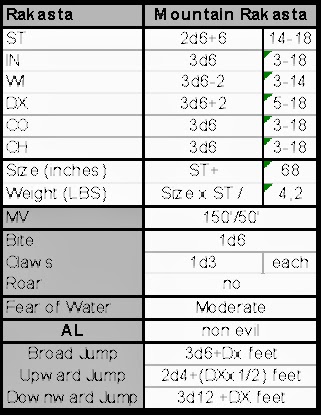
Mountain Rakasta
(From The Rakasta article Of Bruce Heard in Dragon Magazine 247)
All Rakastas can jump as all other humanoids, but the following two are
a bit different.
Mountain Rakasta (Felis
Concolor Rakastus)
Greater Rakasta;
 |
| Source; Unknown |
The Mountain Rakasta have claimed the entire continent of Brun as their
native land. They favor above all unpopulated areas where they can freely hunt.
If unchecked, these adaptable athletes claim any vacant land, including
forests, swamps, grasslands, and semi-desert regions such as Terra Vermelha and
Grande Carrascal in the Savage Coast. Humanoids usually get in their way, both
as prey and hunter. As a result, the widely scattered tribes of mountain
Rakasta have adopted mountain ranges such as the Endworld Line, the Kurish
Massif, and even the Wyrmsteeth Range as their true natural habitat. The
mountain Rakasta’s pelage varies from plain grey-brown, being the most common
in the northern climes, to sometimes reddish or almost black. Accustomed to
broken terrain, these adroit stalkers developed acrobatic skills unparalleled
among Rakasta. Many Humanoids, both with awe and fear, have reported the
ability of the Yutin people, as they call them, to perform stunning leaps. The
mountain Rakasta use this skill to leap over Humanoid camp walls and moats, up
into trees, or down from a rocky ledges, to stalk a prey or evade a sudden
threat. When using their energy burst, mountain Rakasta choose to boost either their
Strength or their Dexterity. They also have a free jumping skill with the some
differences in jumping ranges—see table
Cloud Pardasta (Felis
nebulosa Rakastus)
Wild Rakasta;
 Contrary to what their name seems to Imply, these are not a greater
Rakasta. This wild felid type remains one of the best examples of arboreal
Rakasta and somewhat of a legend as well. Cloud Pardasta live in the forests of
Bellisaria and Skothar, along the Minaean Coast, Tangor Bay, and the Tangor
Peninsula.
 |
| Source; Unknown |
On Skothar, they call Themselves Rimau-Dahan—literally,
fork-of-branch tigers.
Cloud Pardasta gained their name from the large spots on their backs,
which look like cloudy blotches. Their base coats varies from brown to pale or
rich yellow, with white or light tawny on the inner limbs, throat, and chest.
The odd name also comes from their unusual ability. The Cloud Pardasta can
harness natural magical Forces pervading the forest and blend away into its
mist, fog, or clouds. In effect, the Cloud Pardasta can cast dimension door to
a distance of 10’ per experience level, at which point the energy burst ends.
The cloud Pardasta may invoke this power only once a month as it is linked to
the full moon. The Cloud Pardasta must be in contact with forest mist when they
perform the dimension door.
Cloud Pardasta Clans are tucked away in small villages built on the
branches of very tall trees, virtually invisible from the ground. Cloud
Pardasta suffer no movement penalty when inside a tree. They have been observed
by some hunters to sneak or run down tree trunks head first, without any
difficulty whatsoever. They can hang from branches using only their legs, or
run underneath one with ease. Jumping from one branch to another is a native
game, which they do without requiring Dexterity checks or the use of a jumping
skill, unless the distance exceeds 15’ (horizontally or downward). Cloud
Pardasta have free acrobatics skill, as can be expected of arboreal creatures.
To accomplish these feats, the Cloud Pardasta’s long tail must be free to help
balance movements. On the other hand, they lose 2 Dex when caught on the
ground.
Jumping and other creatures than Demi-Human-Oids
Horses and Chevall Jumping
 |
| Source; AD&D MC Mystara Appendix |

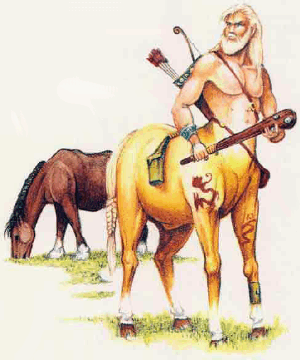
Every Chevall is capable of a maximum height and length when it comes to
jumping. Some are particularly adept at this, while some refuse to
jump at all. Whatever their capabilities, they should be kept on record, and
use it against the immediate needs of any particular situation. Keep in mind
that they are certainly not given to high performance jumping. A running distance
must be preceded by at least 30’ of open ground and full speed. Every
encumbrance step more decreases the jumping distances by one step. A standing
high jump is a jump as high as possible to reach something higher, Chevalls
prefer to rear to reach higher objects as their rearing height is twice their
normal height.
 |
| Artist; Maddie 1101 Deviant Art |
 Every single horse is capable of a maximum height and length (in feet) when it
comes to jumping. Some are particularly adept at this, while some refuse to
jump at all. Whatever an animal’s capabilities, they should be kept on record,
and use it against the immediate needs of any particular situation. Thus roll
1d100 to find how far your horse can jump. Keep in mind that draft horse,
mules, ponies, and the like are certainly not given to high performance
jumping, so give them a penalty of 50% on the distances covered. This penalty
also applies if the creature is loaded (including any riders) over its encumbrance limits. Thus a loaded pony
with a roll of 4 can jump only 1’ high and 3’ far, due doubling of the
penalties
Other Jumping Creatures
Cats; see Monster Manual (found here; http://breathofmystara.blogspot.nl/2013_06_01_archive.html )
Agile creatures like deer, gazelle, rodents can also make great jumps
they can cross distance up to 50% of their normal speed (example; Movement;
210’/70’ = a max jump of 35’ ). Smaller creatures can jump as far as their size
in feet or twice if they are agile jumpers.(high jump ½ this value).
Most other animals (like Dogs, wolves) and carnivorous dinosaurs can
jump only as far as their size, or half this as high. Use this rule if it is
NOT given in the description of the creature.
When not given is the creatures description (see monster manual 1-2 use link given above) use
this standard method instead. Flying creatures don’t jump. Swimming creatures
rarely do, as this requires breaking the surface of rthe water. They would do
so to escape predators, or attack prey. Only rapid swimmers can do this (above
120’-40’ swim movement) They can reach only a distance of 5+1d6+St adjustment
in feet above the water, after which they fall back.
Giant Frog and toads can jump maximum distances far or up. Do not
confuse this with their Hop movement, as these are multiple small hops in
order. Thus a Giant Frog has a movement of 90’/30. Hop 90’/round and maximum
jump of 20’
Falling
 |
| Source; candb.com |
The standard rule of thumb is that one takes 1d6 points of damage for each 10' fallen. that seems to be all right for shorter distances, but it is better to use the following table. This chhart shows the damage from an all-out, unchecked plummet--or a Crash-Dive into the ground. It is easy enough to use. if you fall from an altitude of 80', it takes you less than 2 seconds to hit the ground, and when you do you suffer 6d6 points of damage--easily enough to killl low-level characters and hurt mid-level heroes.
Above 680' , falling characters and other reach what is called Terminal Velocity--meaning the air pressure has stopped their groundward acceleration, they can't fall any faster. therefor it is impossible to take more than 20d6 from falling damage, regardless of how high you are. (Atmospheric re-entry is anorher matter, after breaching the Skyshield, it is best to have some scientific texts on hand to help you explain what's about to happen).
The second chart is also straightforward. if you want to know, for instance, how far you fall on Mystara in 9 seconds, you discover that it's 1248' total. You have reached Mystara's Terminal Velocity of 192'/second by that time.
Flying vessels and cross country aerial travellers tend to fly at an altitude of 15.000' or higher. for every 1440' of altitude you have, you have a full round of preparing time in case something goes wrong.
For those devious DM's that like reality the table is expanded with the broken bones the character sustains on hitting the ground. Keep in mind that this is NEVER more than the total amount of damage sustained. (Thus if only 5 damage is rolled by a fall of 60' and the break roll gives 9 breaks, then the fallen character will have only 5 breaks!!).
To see if a character survives a fall, a special constitution check may be applied to reflect internal damage. This check is adjusted as per table per height.
A Character failing this check, is just dead, instantly. He can be raised as normally, after the body is cured.
The broken bone is checked with the broken bones table found here
Example
Lucius fell 10' thus fell less than 1 second, sustained 3 on 1d6 points of damage, rolled a 2 on his 1d2-1 and thus suffered a break, but his constitution check at a bonus of +8 gave him no problems.
Oswald fel also, Rolled a 1 on damage, but rooled a 1 on breaks, resulting in no broken bones. His constitution check succeeded also.
Important note
0-20.000 feet
The Atmosphere of Mystara is similar from the Outer World to the Hollow World. It remains breathable up to about 20.000 feet.
The highest Mountains break this barrier (ex. The Black Peak Mountains between Hule and the Great Sind Desert are approximately 24.000 feet high). The higher a person goes the colder it becomes, however.
20.000-80.000 feet
Above 20.000' or just shy of 14' rounds falling time, it becomes very difficult to breathe. Above that most living creatures need special breathing gear or Magic. However, above 20.000 feet the atmosphere still provides pressure. A Character above 20.000 feet cannot breathe normally, but will not die by lack of pressure.
80.000 feet or higher The Skyshield
At an altitude of about 80.000’ (about 15 miles), the atmosphere is held in by an envelop of energy. Characters not protected by special devices or magical spells will die—they take 1d6 cold and de-pressure damage per round without a save, until they die or reenter the denser atmosphere. This barrier is called the Sky Shield. Beyond this skyshield a character's body will also not fall but float, until it finally re-enters the Skyshield.
Spells or Objects to prevent Falling
3rd level spell Fly, provided ability to move 360' /round in any direction.
2nd level spell Levitate, provided ability to move up or down 20'/ round.
1st level spell Feather Fall, provides ability to slowly descend at 20'/ round.
Or a Bumberchute (500gp) Gnomish invention; Theis looks like a large parasol and is worn on the back, like a back-slung sword. Whenever falling applies, the character only needs to pull the Bumber-chute forth and press the button on its handle. The umbrella portion will open and magically lower its wielder to the ground. The character need only hold onto the handle for dear life.
When nearing the ground, the character rolls 1d20 on a 1, he takes 2d6 damage from a bad landing, but otherwise lands just fine.The bumber-chute actually lowers those using it at a falling rate of 1000 feet/minute or 166'/ round, with a final bit of extra decelleration at the end, when the 1 is rolled this failed to take effect. Bumberchutes are not customary sold to people outside The Flying city of Serraine, The Knight of the Air and Retebius Air Fleet, both in Thyatis. Some Gnomes however, aware of the secret might copy it.
There is notice by Alphatians who got lost in the western part of Norwold that they encountered Yeti of some sentience, using magically enchanted hang-gliders. (more about this in an upcoming Blog Article.)
 Have fun. Don't break your neck.;)